

Please click on the tables and figures to enlarge
A retrospective analysis of the waiting times for a general anaesthetic for paediatric patients at Croydon University Hospital, a service provided by the special care community dental services - King's College Hospital
S. Shao BSc (Hons), BDS, MFDS RCS Glas, PGCert Special Care Dentistry, PG Cert Dental Sedation
Trust Grade Junior Clinical Fellow in Oral Surgery and Maxillo Facial Surgery, Salisbury District Hospital, Odstock Road, Salisbury SP2 8BJ
Correspondence to: Sabrina Shao
Email: sabrina.shao@nhs.net
DOI: 10.63507/ROAC1804
Abstract
Introduction
General anaesthetic (GA) is a technique that can be used to manage dental anxiety in paediatric patients. The COVID-19 pandemic halted the use of certain treatments and caused a backlog in patients waiting for their treatment.
Objectives
This service evaluation reviewed the number of GA sessions provided by Croydon University Hospital (CUH), the number of patients treated and the waiting time for a dental GA, comparing the results from April 2019 to March 2020, April 2021 to March 2022 and April 2022 to March 2023, and assessing how these elements have been affected since the COVID-19 pandemic.
Method
Data was collected retrospectively, encompassing all scheduled GAs provided by the community dental service at CUH from April 2019 to March 2023.
Results
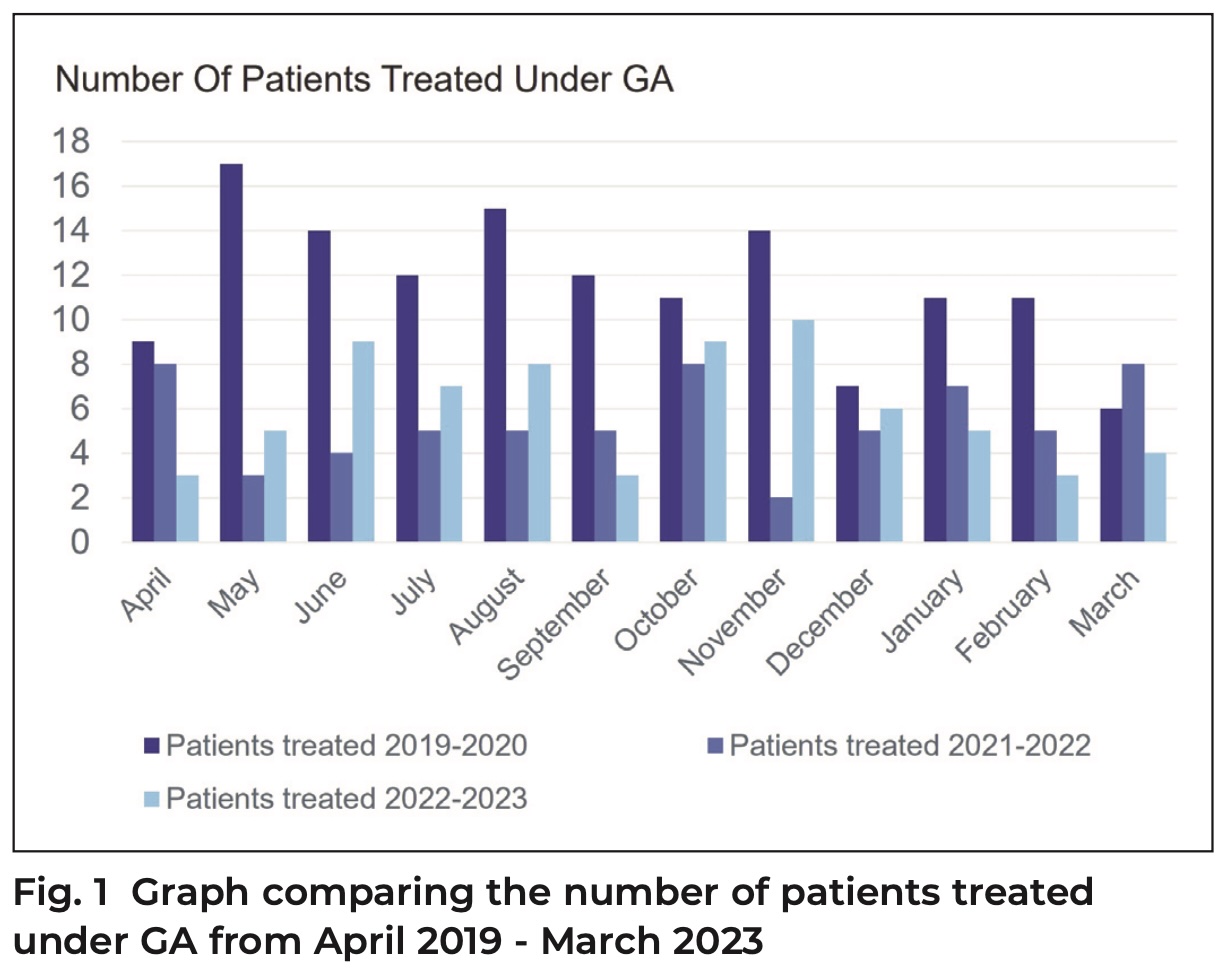
A total of 139 patients were treated under GA in 2019-20. This number decreased to 65 in 2021-22, a 53% decrease, and increased in 2022-23 from 2021-22 by 11% to 72 patients. The number of GA sessions provided was 48 in 2019-20. This reduced by 38% (30 sessions) in 2021-22, whilst 32 sessions were provided in 2022-23. All patients treated over the three-year period were classified as ASA I or ASA II. The longest waiting time was 53 weeks in 2019-20, 123 weeks in 2021-22, and 141 weeks in 2022-23. The number of patients treated within the 18-week target was 57 out of 149 (38%) in 2019-20, 5 out of 75 (<1%) in 2021-22, and 20 out of 79 (25%) in 2022–23.
Conclusions
Although the COVID-19 pandemic significantly impacted service provision, leading to a reduction in the number of sessions and patients treated, along with a marked increase in waiting times, the demand for dental GA is still present.
Key learning points
- GA remains a valuable resource and plays a huge role in enabling dental treatment for paediatric patients
- Due to the impact on National Health Service (NHS) resources and waiting times, prescription of GA should be carefully considered, with behavioural management techniques and conscious sedation employed first, if possible
- Routine monitoring of service capacity against referral demand is essential to ensure timely treatment and prevent backlog accumulation.
Introduction
Dental caries is a common oral disease affecting children in the UK. The Oral Health Survey 2019 showed that 23.4% of five- year-old children in England had experience of obvious dental decay.1
Dental caries can have a significant impact on children’s quality of life,2 with for example, pain leading to outcomes such as disturbed sleep and eating difficulty.3
Sometimes, GA is required to treat children with dental anxiety, limited co-operation or for more complex dental needs, such as removal of impacted teeth. However, for the financial year 2021-22, tooth decay was still the most common reason for hospital admission in children aged between six and ten years.4
For the financial year 2019 -20 £54.6 million was the estimated cost of hospital admissions in 0-19 year olds for all tooth extractions,5 and for the financial year 2021-22 there was an estimated cost of £50.9 million for caries-related tooth extractions.5 These costs are a huge burden on our health service and, even when the benefits outweigh the risks of a GA,6 we must be able to justify its use.7
King’s College Hospital Community Special Care Dental Service; provide a dental GA service at CUH. This service is for patients who reside at a Croydon postcode. The patients are either registered patients at the special care service, thereby meeting certain criteria,8 or they have been referred by their general dental practitioner. Patients who are referred initially have their referral triaged for acceptance, they are then assessed by a dental officer or senior dental officer to assess which treatment option would be most suitable for the patient. If a patient is deemed to require a GA, they will then be assessed by the senior dental officer or consultant in paediatric dentistry to assess their suitability for a GA. A senior dental officer in paediatric dentistry is an experienced dentist with experience in managing the dental care of children within the CDS. Once confirmed that a GA is indicated, the patient is consented and placed on a waiting list for their GA treatment. The treatment level that is provided by this service is comprehensive care.
This evaluation also investigated the waiting times for the patient. The NHS set a standard that 92% of patients waiting for elective treatment should wait no longer than 18 weeks from referral to their first treatment.9
Methods
The inclusion criteria for this service evaluation were all scheduled paediatric GAs provided by the King’s College Hospital Community Special Care Dental Service at CUH, from April 2019 to March 2023. The cases were identified retro- spectively using the dental electronic database, where all subsequent information regarding the patient's care was stored. All data was collected and stored in compliance with data protection requirements. The data that was collected included:
- Number of patients treated
- Number of patients booked and not treated on the day
- Total number of GA sessions
- ASA of patients treated
- Waiting times
Results
Number of patients treated
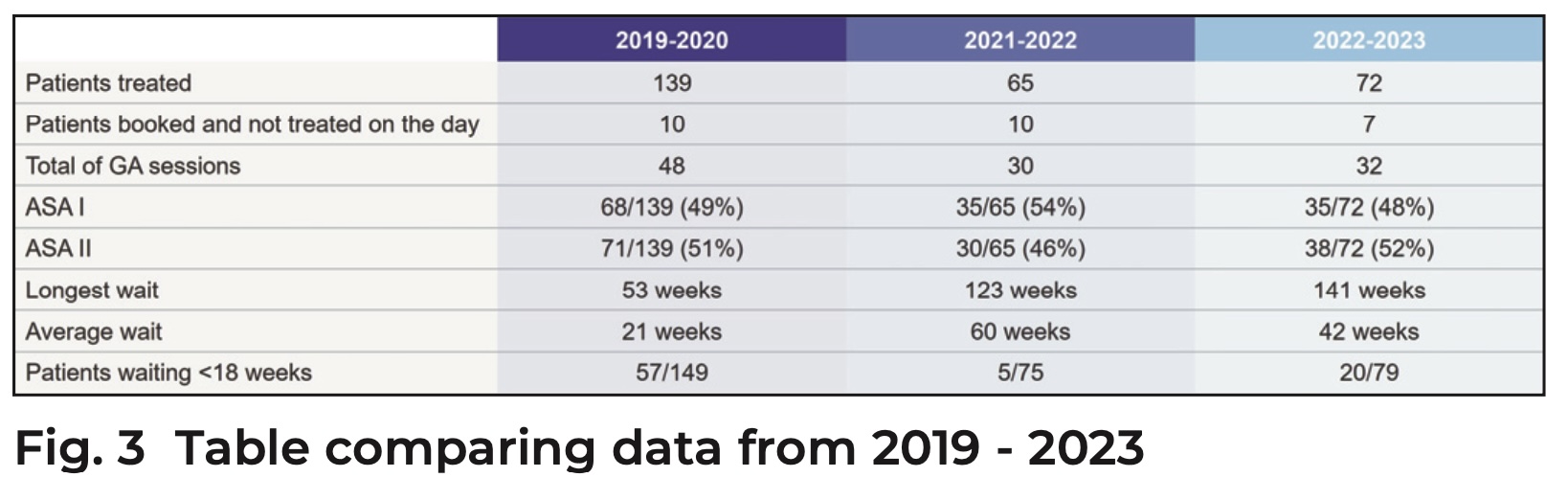
In 2019–20, 139 patients were treated under GA. This decreased to 65 patients in 2021–22, which was a 53% decrease. In 2022-23, 72 patients were treated, although this increased by 11% from the year before, it was still a 48% decrease from the number of patients treated in 2019-20.
Number of patients booked and not treated on the day
In 2019–20, ten patients were booked but not treated on the day. In 2021-22, the same number (ten patients) were not treated on the day. In 2022–23, this figure decreased to seven patients. This could have been due to patients not being brought to their GA appointment, or due to their treatment being cancelled by the anaesthetist.
Total number of GA sessions
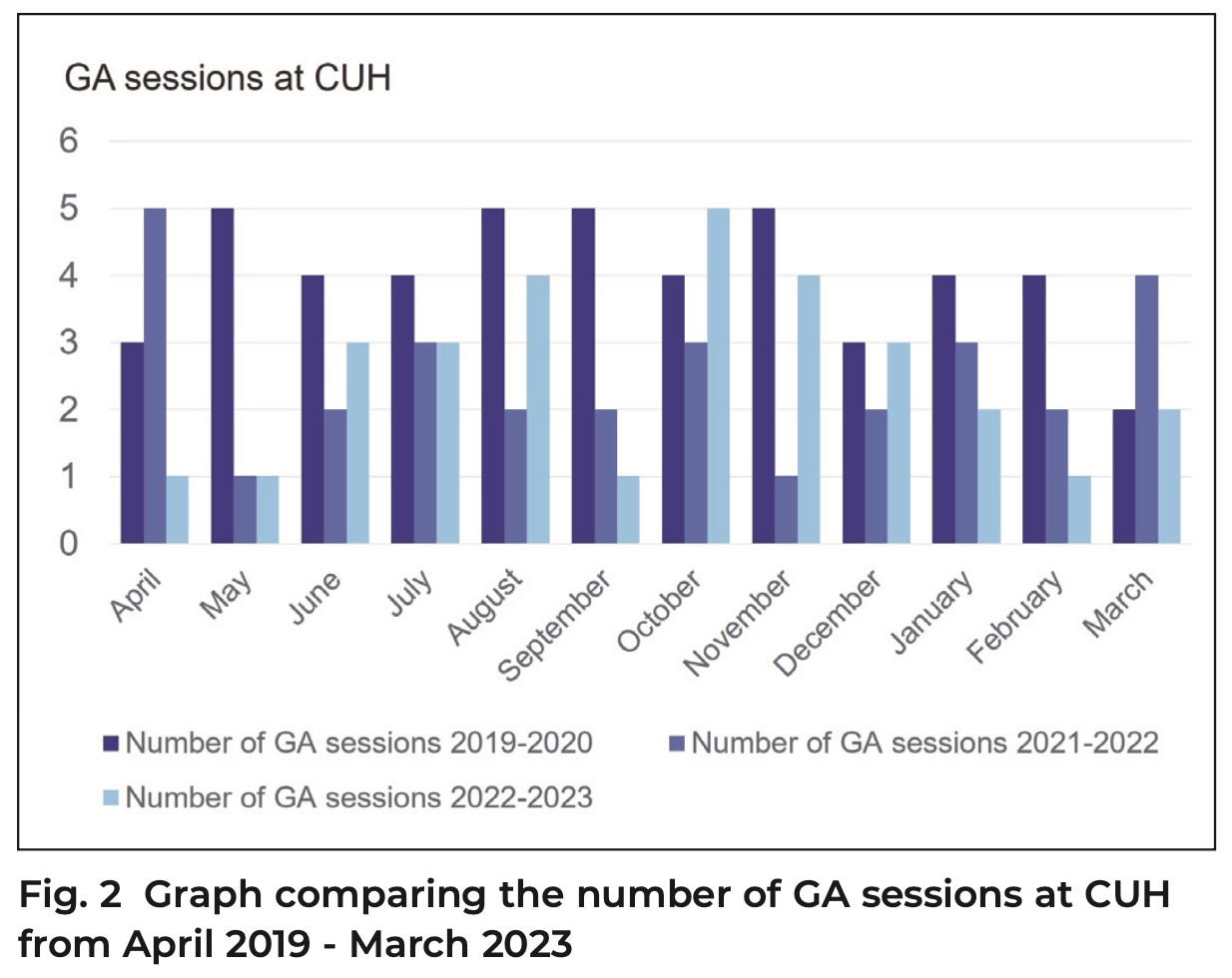
There were 48 GA theatre sessions in 2019–20. This number dropped to 30 sessions in 2021–22 which is a 38% decrease. In 2022-23, there were 32 sessions, although this is a 7% increase in sessions from 2021-22, it was a 33% decrease from 2019-20.
ASA of patients treated
All patients treated across the three-year period were classified as ASA I or ASA II.
Waiting times
The longest individual waiting time was 53 weeks in 2019-20, 123 weeks in 2021-22, and 141 weeks in 2022–23. In terms of patients treated within the target of under 18 weeks from referral, 57 out of 149 patients (38%) met this target in 2019-20, five out of 75 patients (<1%) in 2021-22, and 20 out of 79 patients (25%) in 2022-23.
Discussion
This retrospective service evaluation demonstrated significantly extended waiting times for a paediatric dental GA at CUH. With the longest waiting time being over two years in 2022-23, such prolonged delays reflect a wider issue within the UK paediatric dental services, where increased demand and decreased capacity due to the COVID-19 pandemic have contributed to the growing backlog. The number of GA sessions fell from 48 in 2019-20 to 30 in 2021-22, and although this rose slightly to 32 in 2022-23, it remained below pre- pandemic levels. This decline coincided with a halving of the number of patients treated and an increase in the longest individual wait from 53 to 141 weeks. These delays are indicative of a wider systemic challenge in the provision of paediatric dental services across the UK. Nationally, elective care services experienced major disruption during the COVID-19 pandemic. Due to this, CDS at King’s College Hospital, had no dental GA sessions at CUH for paediatric dental treatment between April 2020-March 2021. The implications of such delays are highly significant. It is well known that dental decay in children can impact their everyday lives, for example, causing pain, difficulty eating and sleeping, weight loss and affecting self-esteem.10, 11
Studies have also found associations between untreated dental disease and disrupted schooling, social withdrawal, and behavioural issues.12
Public Health England (now the UK Health Security Agency) highlighted in its reports that untreated dental caries is a major contributor to childhood hospital admissions,13, 14 and therefore, the need for timely intervention is paramount.
It is important to consider that there is the potential for a change in a child’s treatment needs or co-operation over time. As children develop, they may have increased understanding, potentially allowing for treatment under less invasive means15 including behavioural management techniques, local anaesthetic or conscious sedation.16 Without interim assessments, however, these developments are often missed, leading to continued reliance on GA and sub-optimal use of NHS resources. As part of a broader response to backlogs, sustainable use of paediatric services and investment in preventive dental care are essential strategies.
It is also important to note that patients who are booked in for GA treatment but not treated on the day, could be accounted for by various reasons. This might include their not being brought to their GA appointment, or due to their treatment being cancelled by the anaesthetist; or due to clinical or safety concerns. Such cases clearly result in wasted NHS resources.
Recommendations
With the longest wait for a dental GA being 141 weeks, the introduction of a reassessment protocol during the waiting period could help identify patients who have become suitable for alternative treatment modalities such as behavioural management techniques, local anaesthesia or conscious sedation. This would optimise resource use and reduce unnecessary reliance on GA. A triaging system could also aid in prioritisation based on clinical urgency, and the identification of patients who no longer require GA. This targeted approach would support more efficient list management and better match patients to the most appropriate treatment modality.
To help reduce the numbers of wasted appointments from patients who are booked for a GA but not treated on the day, reminder calls that reiterate pre-operative instructions are recommended. Encouraging early cancellations can allow another patient to be added to the list, thereby maximising service efficiency. As mentioned above, interim assessments can help to avoid unnecessary GAs. Safeguarding follow up may be appropriate for paediatric patients who are repeatedly not brought to their appointments.
Due to the reduction in GA sessions along with a decline in the number of patients treated and an increase in waiting times during and following the COVID-19 pandemic, attempts, where feasible, should be made to address backlog pressures.
Conclusion
GA remains a critical resource for delivering dental treatment to paediatric patients who are unco-operative employing other treatment modalities. CUH supports the community dental service by providing GA sessions for patients under 16 years of age who are classified as ASA I or II. The COVID-19 pandemic significantly impacted service provision, leading to a reduction in the number of sessions and patients treated, along with a marked increase in waiting times. As a result of this, many paediatric patients would have experienced prolonged periods of dental pain and were at increased risk of dental infection and deterioration of their oral health.
Acknowledgements
Thank you to Dr F Taleifaz and Dr A Kyriazidou, special care community dental services, King’s College Hospital, for their support in carrying out this project.
Declaration of Interest
None declared.
References
1. Public Health England. Oral health survey of 5-year-old children. 2019. Online information available at https://www.gov.uk/government/statistics/oral-health-survey-of-5-year-old-children-2019 (accessed June 2025).
2. Gilchrist F, Marshman Z, Deery C, Rodd H D. The impact of dental caries on children and young people: what they have to say? Int J Paediatr Dent 2015; 25: 327–338. DOI: 10.1111/ipd.12186.
3. Alsumait, A., El Salhy, M., Raine, K. et al. Impact of dental health on children’s oral health-related quality of life: a cross-sectional study. Health Qual Life Outcomes 2015; 13, 98. DOI: 10.1186/s12955-015-0283-8.
4. Office for Health Improvement & Disparities. Hospital tooth extractions in 0 to 19 year olds. 2022. Online information available at https://www.gov.uk/government/statistics/hospital-tooth-extractions-in-0-to-19-year-olds-2022 (accessed May 2025).
5. Public Health England. Hospital tooth extractions of 0 to 19 year olds. 2019. Online information available at https://www.gov.uk/government/publications/hospital-tooth-extractions-of-0-to-19-year-olds (accessed June 2025).
6. Royal College of Anaesthetists. Risks associated with general anaesthesia. Online information available at https://www.rcoa.ac.uk/patients/patient-information-resources/anaesthesia-risk/risks-associated-general-anaesthesia (accessed May 2025).
7. The Royal College of Surgeons England. UK National Clinical Guidelines in Paediatric Dentistry Guideline for the Use of General Anaesthesia (GA) in Paediatric Dentistry. 2008. Online information available at https://www.rcseng.ac.uk/-/media/files/rcs/fds/publications/guideline-for-the-use-of-ga-in-paediatric-dentistry-may-2008-final.pdf (accessed May 2025).
8. Community special care dentistry. Online information available at https://www.kch.nhs.uk/services/services-a-to-z/community-special-care-dentistry/ (accessed May 2025).
9. National Health Service. Referral to treatment. Online information available at https://www.england.nhs.uk/rtt/ (accessed June 2025).
10. The Royal College of Surgeons of England. The state of children’s oral health in England. 2015. Online information available at https://www.rcseng.ac.uk/-/media/files/rcs/about-rcs/government-relations-consultation/childrens-oral-health-report-final.pdf (accessed June 2025).
11. Department of Health. Choosing Better Oral Health An Oral Health Plan for England. 2005. Online information available at https://data.parliament.uk/DepositedPapers/Files/DEP2008-2661/DEP2008-2661.pdf (accessed June 2025).
12. Pine C M, Harris R V, Burnside G, Merrett M C. An investigation of the relationship between untreated decayed teeth and dental sepsis in 5-year-old children. Br Dent J. 2006;200: 45-7. DOI: 10.1038/sj.bdj.4813124.
13. Office for Health Improvement & Disparities. Short statistical commentary for hospital tooth extractions in 0 to 19 year olds. 2024. Online information available at https://www.gov.uk/government/statistics/hospital-tooth-extractions-in-0-to-19-year-olds-2024/short-statistical-commentary-for-hospital-tooth-extractions-in-0-to-19-year-olds-2024 (accessed June 2025).
14. National Health Service England Digital. Hospital Admitted Patient Care Activity, 2023-24 Hospital Admitted Patient Care Activity, 2023-24. Online information available at https://digital.nhs.uk/data-and-information/publications/statistical/hospital-admitted-patient-care-activity/2023-24(accessed June 2025).
15. Ashley P F, Williams C E C S, Moles D R, Parry J. Sedation versus general anaesthesia for provision of dental treatment in under 18 year olds. Cochrane Database of Systematic Reviews 2012, Issue 11. DOI: 10.1002/14651858.CD006334.pub3.
16. National Institute for Health and Care Excellence. Sedation in under 19s: using sedation for diagnostic and therapeutic procedures. 2010. Online information available at https://www.nice.org.uk/guidance/cg112/chapter/Key-priorities-for-implementation (accessed June 2025).
17. Knapp R, Marshman Z, Rodd H. Treatment of dental caries under general anaesthetic in children. BDJ Team 4 2017, 17116. DOI: 10.1038/bdjteam.2017.116.
18. Scottish Dental Clinical Effectiveness Programme Prevention and Management of Dental Caries in Children. 2025. Online information available at https://www.childcaries.sdcep.org.uk (accessed May 2025).