
Erratum SAAD Digest 41(1) 2025
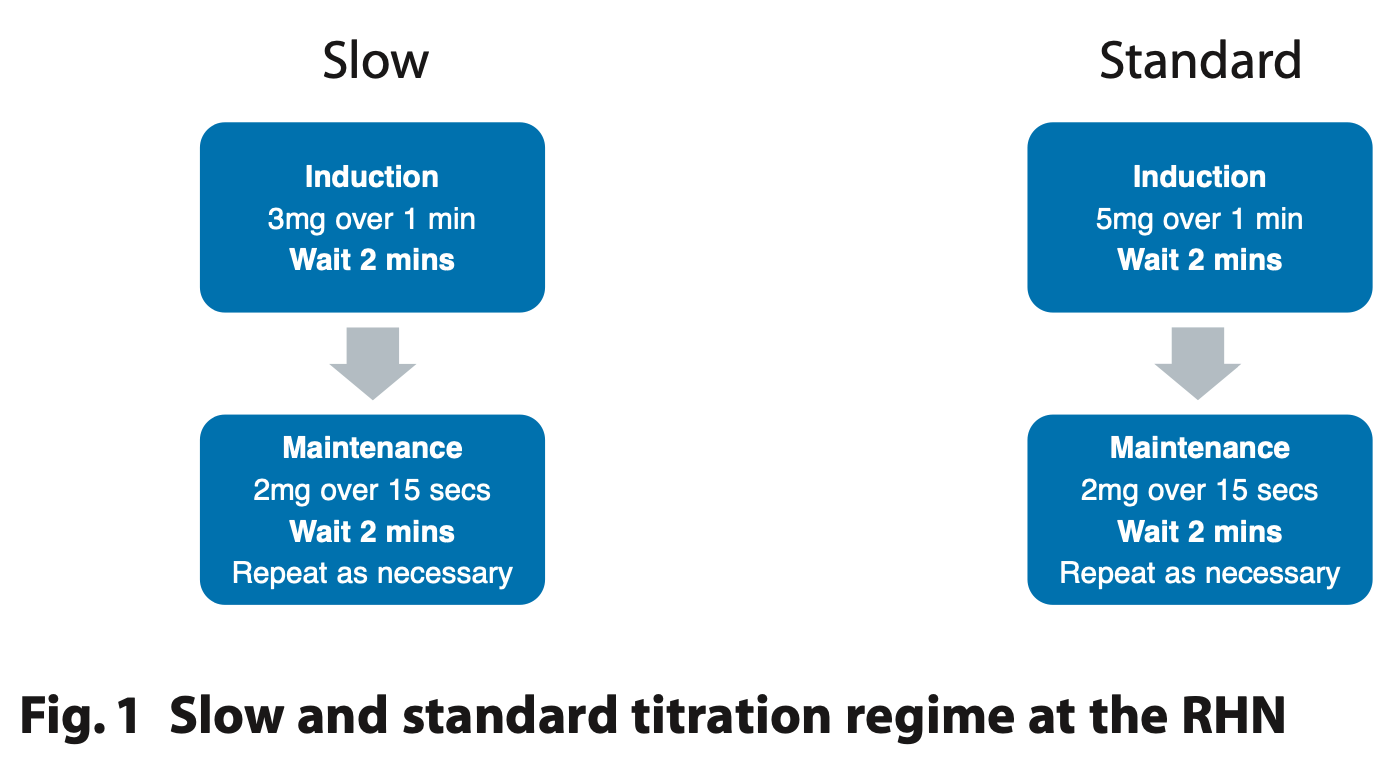
In some of the printed copies of SAAD Digest 41(1) 2025 there is a printing error on page 23 Figure 1.
The lower box under the standard titration regime should indicate a maintenance dose of 2 mg over 15 seconds as shown below.
Correspondence
The following correspondence was received in relation to the referreed paper entitled: Challenges and considerations in dental treatment of patients with psychogenic non-epileptic seizures: a review and case study
I was concerned about an article I came across in the SAAD Digest that has been published. It's a topic of particular interest to me, that unfortunately left me rather dismayed on reading it. In particular, I was extremely disappointed to come across the titular piece in Vol 41(I) 2025 of SAAD Digest relating to 'psychogenic' non-epileptic seizures.
The term 'psychogenic' as relates to non-epileptic seizures is now outdated and indeed would be considered by many suffering from non-epileptic seizures as offensive. Use of the term and the way in which it has apparently been accepted as lexicon by the authors, unfortunately serves only to reinforce outmoded, prejudiced and unsubstantiated hypotheses as to the nature of such events in those who suffer them.
Functional is a far more up-to-date term, which does not make the assumption or inference that their primary cause is related to psychogical factors. It is not simply an alternative term, it is an evolutionary one, based on updated collective understanding and observations in the field of neurology. Simply put, we, collectively, do not know the cause of such seizures. The use of the term 'psychogenic' strongly implies we do. I would strongly urge a reflection and further reading on the part of the authors, and given the gravity of perpetuating outmoded vocabulary in what is a scientific publication, some input and clarity from SAAD. There is a considerable amount of information out there, going back over a decade ago.
Of course, I appreciate opinions and inferences from research and publications will vary... even and especially between peers! It does however become an issue when people could be either directly or indirectly harmed. Certainly, it is reasonable to consider the term psychogenic and make reference to it from a historical perspective. But only to that extent. We need to move forward and away from outmoded terms, especially those that could serve to offend, and compromise rather than assist the relationship between clinician and patient.
C. Brown
The authors of the refereed paper were asked to comment on this feedback. Their reponse is detailed below:
Thank you for your thoughtful feedback regarding our article on psychogenic non-epileptic seizures in SAAD Digest Vol 41(I) 2025.
I appreciate you taking the time to share your concerns about the terminology used. You've raised an important point about the evolution of medical terminology, particularly the shift from 'psychogenic' to 'functional' seizures. I acknowledge that terminology in this field has indeed evolved with 'functional' now being the preferred term in contemporary neurological practice.
The first line in the abstract acknowledges different terminologies used for these seizure types including functional seizures and dissociative seizures. The idea behind using PNES instead of using functional at the time of the publication was to be streamlined with other publications on the topic. However, we value this feedback and will be more mindful of using current, patient-centered terminology in future publications. I appreciate your advocacy for patients who experience these seizures and your commitment to advancing how we discuss neurological conditions.
The primary aim of our publication was to address a significant gap in dental literature regarding functional seizures, raising awareness of their prevalence and offering guidance on providing safe dental care for this underserved patient population. There is indeed a scarcity of dental-specific research and clinical guidance in this area, which prompted our focus on this important topic.
H. Patel and C. Boynton
Nigel Robb, Editor